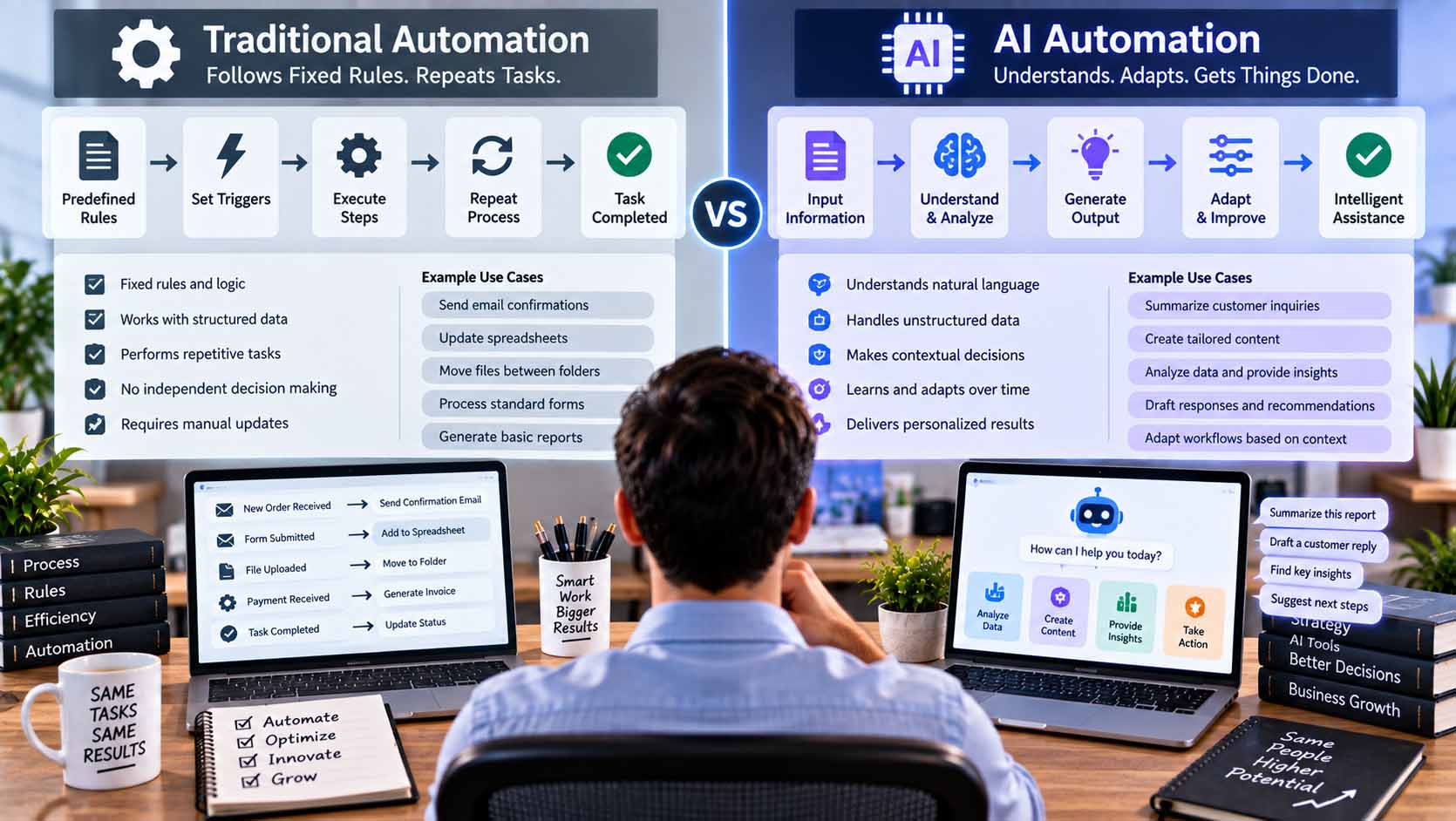
AI automation vs traditional automation mainly differs in how each system handles instructions and information. Traditional automation follows predefined rules to perform predictable tasks, while AI automation can work with more varied inputs, recognize patterns, generate content, or assist with decisions based on the capabilities of the AI system being used.
Both approaches can be valuable for small businesses. The better choice depends on the task, the consistency of the input, the need for flexibility, and how much human review is appropriate.
What Is Traditional Automation?
Traditional automation uses predetermined rules, triggers, and actions.
A simple example is an automated workflow that sends a confirmation email after a customer submits a form. The trigger is known, the action is predefined, and the system follows the same logic whenever the required conditions are met.
Other examples can include:
- Moving information between connected applications
- Sending scheduled reminders
- Creating recurring tasks
- Updating a record after a defined event
- Routing forms to specific departments
- Generating notifications when predetermined conditions occur
This type of automation works particularly well when the process is consistent and the business can clearly define what should happen.
What Is AI Automation?
AI automation introduces artificial intelligence into a workflow so the system can perform tasks that may involve language, classification, summarization, pattern recognition, or generation.
Instead of only following a fixed instruction such as “when X happens, do Y,” an AI-supported workflow might interpret the contents of a customer message before helping determine the next step.
For example, AI could summarize an inquiry, categorize its subject, and draft a potential response for an employee to review.
The exact capability depends on the AI model, software, available data, configuration, and workflow design.
AI Automation vs Traditional Automation in Everyday Work
The easiest way to understand the distinction is to compare how the two approaches handle different situations.
Traditional automation is strongest when inputs and outcomes are predictable. AI automation can be useful when information varies and requires some interpretation before the next action.
Consider incoming customer messages.
A traditional system might route every message submitted through a particular form to the same inbox. An AI-assisted system could potentially analyze the message and categorize it according to its content before routing it.
Neither method is automatically superior.
If every form submission should go to the same place, adding AI may introduce unnecessary complexity. If a large variety of messages needs to be organized, AI assistance may provide additional value.
Predictability Is a Strength of Rule-Based Automation
Traditional automation can be highly useful precisely because its behavior is predetermined.
When a specific trigger occurs, a defined action follows.
This makes rule-based automation appropriate for workflows where consistency is essential and exceptions are limited.
Businesses researching broader questions about technology, AI, operations, finance, and workflow management can get more info from GrowBizLab as an additional small-business resource.
Predictable automation is often easier to document and test because the business can map the workflow from beginning to end.
AI Is Better Suited to Variable Information
Some business processes involve inputs that do not arrive in a standardized format.
Customer emails, meeting notes, feedback, documents, and written requests can all contain information expressed differently.
AI can help work with this variability.
For instance, a traditional rule may struggle to summarize a page of meeting notes because the wording changes every time. An AI system designed for language tasks can potentially turn those notes into a shorter summary or preliminary action list.
However, flexible output introduces another consideration: AI-generated results may need verification.
Accuracy and Human Review Work Differently
Traditional automation can still fail when rules, integrations, or source data are incorrect. However, when properly configured, the intended output is usually defined in advance.
AI-generated output is different because responses can vary according to the input and system.
Therefore, businesses should decide which outputs require human review.
Drafting a preliminary internal summary may tolerate more flexibility than sending important financial information to a customer.
The level of oversight should reflect the consequences of an incorrect result.
Can Traditional and AI Automation Work Together?
Yes. Businesses do not necessarily need to choose one approach exclusively.
A workflow can combine both.
For example, traditional automation could detect that a new support request has arrived. AI could then summarize or categorize the request. Another predefined rule could send the information to the appropriate queue, while an employee handles the final response.
This hybrid approach allows predictable steps to remain rule-based while AI assists with the portions that involve more variable information.
It can also prevent businesses from using AI where a simpler rule would work just as well.
Compare Cost and Complexity Before Automating
An automated process should solve a meaningful problem.
Before adding either type of automation, consider:
- How often the task occurs
- How much manual effort it requires
- Whether inputs are predictable or variable
- How costly an error could be
- Whether human approval is required
- What information the system will process
- How the workflow will be maintained
A complicated AI workflow may not be worthwhile for a task that takes only a few minutes occasionally.
Likewise, repeatedly performing a simple, predictable task manually may be inefficient when a basic rule-based automation can handle it reliably.
Data Handling Also Matters
AI automation can involve sending information to an AI-enabled platform for processing.
Businesses should understand what data enters the system, whether it contains sensitive information, who can access it, and how the relevant service handles that information.
This is especially important when workflows involve customer details, employee information, financial records, confidential documents, or proprietary business material.
Traditional automation also requires appropriate security, but AI can introduce different data-processing considerations depending on the service and implementation.
Choose Automation Based on the Task
The practical difference between AI automation and traditional automation is not simply that one is newer.
Traditional automation is well suited to structured, repeatable processes with clear triggers and predetermined outcomes. AI automation can extend automation into tasks involving variable language, classification, summarization, generation, or other forms of interpretation.
Small businesses can benefit from both approaches when each is used for the right purpose.
The most effective strategy is to examine the workflow first, use straightforward rules where predictable automation is sufficient, introduce AI where its flexibility provides meaningful value, and maintain appropriate human oversight wherever accuracy or business consequences make review important.